Festival Guidelines 2025, which contribute to the advancement of professional and ethical standards in the field of public information for children and young people.
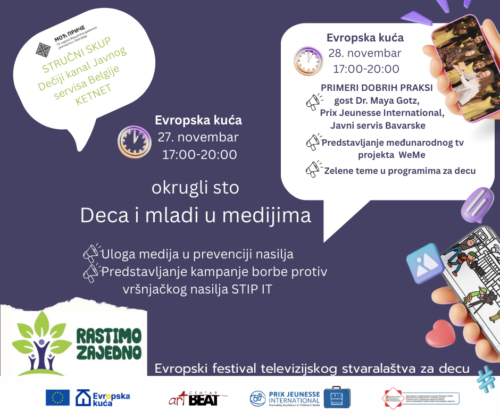
The expert panels within the European Festival Let's Grow Together were held from November 26–28, 2025. Participants in the roundtable discussions included: Ljubica Belanski Ristić (CEDEUM, Bitef Polifonija, Skozorište), Prof. Jelena Vranješević, Prijatelji dece Srbije, Mila Manojlović, Sale Ivanović i Tricky art studio, Aleksandra Mitrić Štifanić ispred festivala Prvi kadar, studenti katedre FTV Produkcija Fakulteta Dramskih umetnosti u Beogradu, PU Mikolu, srednjoškolci, prijatelji i saradnici Art beat centra.
The festival would like to thank Bart Peeters, Annemie Gulickx ( KETNET) i Maya Gotz ( Prix jeunesse Internnational and IZI Institut) for the privilege of hearing them, gaining insight into good European public service media practices, and learning from the experiences of experts who have been working for decades on improving the representation of children in the media and on children’s active participation in media.
Guidelines contributing to the advancement of professional and ethical standards of the expert conference held at the Faculty of Dramatic Arts.
At the Department of Film and Television Production of the Faculty of Dramatic Arts, an expert panel was held for first and second year students who are just stepping into the world of television systems, public service media, and production responsibilities. For that reason, the encounter with the editors of Ketnet, one of Europe’s most successful children’s channels, was a particularly inspiring introduction to understanding what a public service broadcaster looks like when it truly serves its audience.
Throughout the conversation, it became evident that in an age dominated by global platforms, endless franchises and algorithms that make choices on our behalf, quality children’s content is not a luxury but an essential need. Ketnet, a channel that has been shaping its unique identity since 199,7 shows that a public service broadcaster can be contemporary, humorous, imaginative, and profoundly accountable. Their approach is built around four clear yet powerful values: trust, authenticity, playfulness, and participation. And the outcome? Children experience Ketnet not simply as a television channel, but as a space where they feel protected, acknowledged, and genuinely involved.
The editors described how children actively take part in shaping the program: through focus groups, shows in which they participate, topic suggestions, and ongoing dialogue with the production team. This closeness is the reason Ketnet has been building its reputation for decades as a trusted brand, not because it is written in a strategy, but because both children and their parents genuinely trust it. In the digital environment, the channel goes a step further: it offers content across multiple platforms, yet without advertisements or user tracking, demonstrating that technological advancement does not have to conflict with children’s rights
What stood out was their social mission, exemplified through the campaign Stip it one of the most recognizable European movements against peer violence. Created entirely with Ketnet’s own resources, the campaign began as a creative initiative by children who, in 2012, raised their voices against violence through dance across the country. Today, Stip it it brings together the entire community, symbolized by the simple yet powerful sign of four dots and extends beyond Belgium—from Flanders, through Brussels, to Denmark and Slovenia. Evaluation results confirm its impact: 85% of primary school children recognize the campaign and one-third of citizens believe it is now easier to talk about violence than before the campaign was launched.
The guidelines derived from the conference conclusions point to one important insight: Ketnet is proof that a public broadcaster can be popular without compromise—educational and entertaining without resorting to trivialization. For students and future producers, this case study opens the door to a new way of thinking about children’s media—as a space that inspires, connects, and drives positive social change. Ketnet’s practice serves as a reminder that responsibility and creativity are the strongest allies of any public service aiming to remain relevant. And when children are placed at the center, media acquires an entirely new meaning.
Guidelines and conclusions from the second day of the expert conference: Children and Youth in the Media
On the second day of the expert panel, we opened a space to reflect on how contemporary media perceive children and how children perceive the media. The discussion began with a quote from the book Nevidljivo dete, Nade Korać i Jelene Vranješević, koji kroz blagu ironiju prikazuje koliko je percepcija deteta kao as a helpless human being deeply rooted in society. Nearly a quarter of a century after the research on which the book is based, it is evident that the lack of understanding of the media’s role in children’s lives, as well as the importance of their participation, has not diminished. On the contrary, in many areas, the situation has become even more complex today.
Young participants of the panel spoke from personal experience: they do not perceive the media as a space that belongs to them. They do not see themselves, their topics, or their dilemmas reflected. The educational system, which should serve as a support in combating peer and media violence, rarely intervenes when it is most needed. Formal protocols exist, but they remain little more than a list of good intentions. Young people feel insufficiently accepted, misunderstood, and without clear institutional support. Those who are luckier find refuge in small creative communities—art workshops and educational programs—but this is not a solution that reaches everyone.
In this context, the presentation of the Belgian children’s channel Ketnet and their campaigns against violence Stip it felt refreshing and encouraging. Ketnet bases its work on a simple yet powerful principle: every piece of content must start from the perspective of the child’s rights. The editors explained how they consistently resist commercial pressures, create a safe space for children, and involve them in the content creation process. Their decision to fund the anti-violence campaign with their own resources—because they see it as a “duty to society and the future”—left a strong impression. The results of the Stip It campaign demonstrate that media, when they take responsibility, can truly change social behavior patterns.
Participants agreed that the key to developing high-quality media content for children lies in the good will of the media themselves. A legal framework that would obligate them to protect children’s rights still practically does not exist. This results in media rarely considering that their content will be viewed by children and young people. Such an approach is reflected in the broader social climate—children remain on the margins, and their experiences and needs remain invisible.
The experiences of experts from various countries showed that Serbia is significantly lagging when it comes to the participation of children and youth in society and the media. While global trends involve young people in content creation, here their voice remains more of an exception than the rule.
The conclusion of the day was clear: children and young people are not passive media consumers, but an important and equal part of the public sphere. Without their visibility, there can be no high-quality media, no effective prevention of violence, and no society that understands its own future. The guidelines for how media in Serbia should function are reflected in the way Ketnet affirms children’s voices in the public space. Ketnet’s example shows that, with knowledge, dedication, and a bit of courage, it is possible to create a media environment that truly belongs to children. It is up to us to begin building such a space in our own society.
Guidelines and conclusions from the third day of the expert conference: Share-pool models and green themes for the youngest audiences
The third day of the expert panel brought the deepest reflections on how contemporary media can (and must) respond to the needs of children growing up in a complex, ever-changing world. The central guest of the program was Maya Gotz, the director of the Munich Prix Jeunesse and head of the IZI Institute, whose decades-long practice researching the relationship between children and media represents an international standard in the field. Her presentation raised a question that increasingly shapes global strategies for public service broadcasters and independent productions: whether “share pool” initiatives could be the future of children’s media programming.
This collaborative model allows content to be created with simultaneous attention to local identity and global comprehensibility, enabling each country to offer its original perspective while collectively building a unified narrative that reaches children worldwide. Within this framework, the international series WeMe, created in collaboration with over forty countries, including Serbia. A special segment of the project highlights how preschoolers around the world experience nature, while the use of artificial intelligence enables their stories to be translated across language barriers without diminishing the authenticity of their voices.
What left the strongest impression on the panel participants were the video clips showing children’s reactions to various media content—moments of delight, curiosity, but also discomfort or disinterest. For anyone working with children and youth, these materials are invaluable because they clearly demonstrate the importance of seeing children not merely as an audience, but as active collaborators in the creative process. While adults are routinely asked for their opinions on every product, children are often excluded, based on the assumption that they already know them or that we remember how we once thought. However, contemporary research, as well as field experiences, confirm the opposite: the best guidelines for creating high-quality children’s programming come—from the children themselves..
For this reason, children’s participation in media creation was presented not as a desirable added value, but as a necessary prerequisite for the development of relevant and ethical content. Today, children are exposed to intense media pressure—from sensationalist headlines to dramatic narratives about global crises. Climate change, a topic from which share pool the WeMe project originated, is often portrayed in the media as an imminent threat, without clear explanation or context. Such an approach does not protect children; rather, it leaves them in a vacuum of fear and uncertainty.
The conclusions of the third day showed that there are no “taboo” or difficult topics for children—there are only wrong ways to present these topics. Children understand more than adults often acknowledge. Honest conversations about problems and their possible solutions give them a sense of inclusion and security. Hiding information out of fear that it might upset them actually causes the most harm: it creates a gap between their lived experience and the world we show them.
The guidelines can be summed up in a simple message: the future of children’s media must be based on their participation. —in decision-making, in content creation, and in shaping narratives that reflect the world they live in and will one day lead. Children do not need a simplified version of reality, but a space to explore, understand, and participate in changing it.
The conclusions and guidelines derived from the expert conference confirmed that innovation in media creation does not begin with technology, but with listening. And when we truly listen to childrentheir questions, fears, ideas and ,it becomes clear that their participation is the most reliable path toward creating a sustainable, high-quality, and socially responsible media landscape.